The French and Indian War is often treated as a separate chapter from the revolutionary events that followed, yet it set in motion many of the political, economic, and social conditions that ultimately led to the Boston Tea Party. The connection between the two lies not in a single direct cause, but in a chain of consequences that transformed the relationship between Great Britain and its American colonies.
Before the war, the colonies, particularly those in places like Boston, enjoyed a relatively loose relationship with British authority. This period is sometimes described as “salutary neglect,” where Britain allowed colonial governments significant autonomy in exchange for loyalty and economic cooperation. Whilst trade was regulated through laws such as the Navigation Acts, enforcement was often inconsistent, and colonists became accustomed to a degree of independence in managing their own affairs.
The French and Indian War changed this dynamic dramatically. Fought between British and French forces, along with their respective Native American allies, the conflict was expensive and complex. Although Britain ultimately emerged victorious, gaining control of vast territories in North America, the cost of that victory was immense. The British government was left with a significant national debt and the ongoing expense of maintaining troops in the colonies to defend newly acquired lands.
From the British perspective, it seemed reasonable that the American colonies should contribute more directly to the costs of their own defense. However, the method chosen to achieve this would prove deeply controversial. Beginning in the mid-1760s, Parliament introduced a series of taxes and regulations aimed at raising revenue from the colonies. Measures such as the Sugar Act and the Stamp Act marked a shift from regulating trade to directly taxing colonial populations.
This shift was crucial. Colonists had long accepted trade regulations, but direct taxation without representation in Parliament challenged their understanding of their rights as British subjects. The phrase “no taxation without representation” became a rallying cry, reflecting a broader concern that Britain was overstepping its authority. Resistance began to organize, particularly in urban centers like Boston, where merchants, artisans, and political leaders were closely connected.
As tensions grew, further legislation followed. The Townshend Acts of 1767 placed duties on imported goods such as glass, paper, paint, and tea. Although some of these duties were later repealed, the tax on tea remained, symbolizing Parliament’s claim to the right to tax the colonies. Opposition to these measures led to boycotts, protests, and increasing friction between colonists and British officials.
The presence of British troops in Boston, initially intended to enforce order and protect imperial interests, only intensified these tensions. The situation eventually erupted in the Boston Massacre, where a confrontation between soldiers and civilians resulted in the deaths of five colonists. While not directly linked to taxation policy, the massacre reinforced colonial fears about British authority and contributed to a growing sense of grievance.
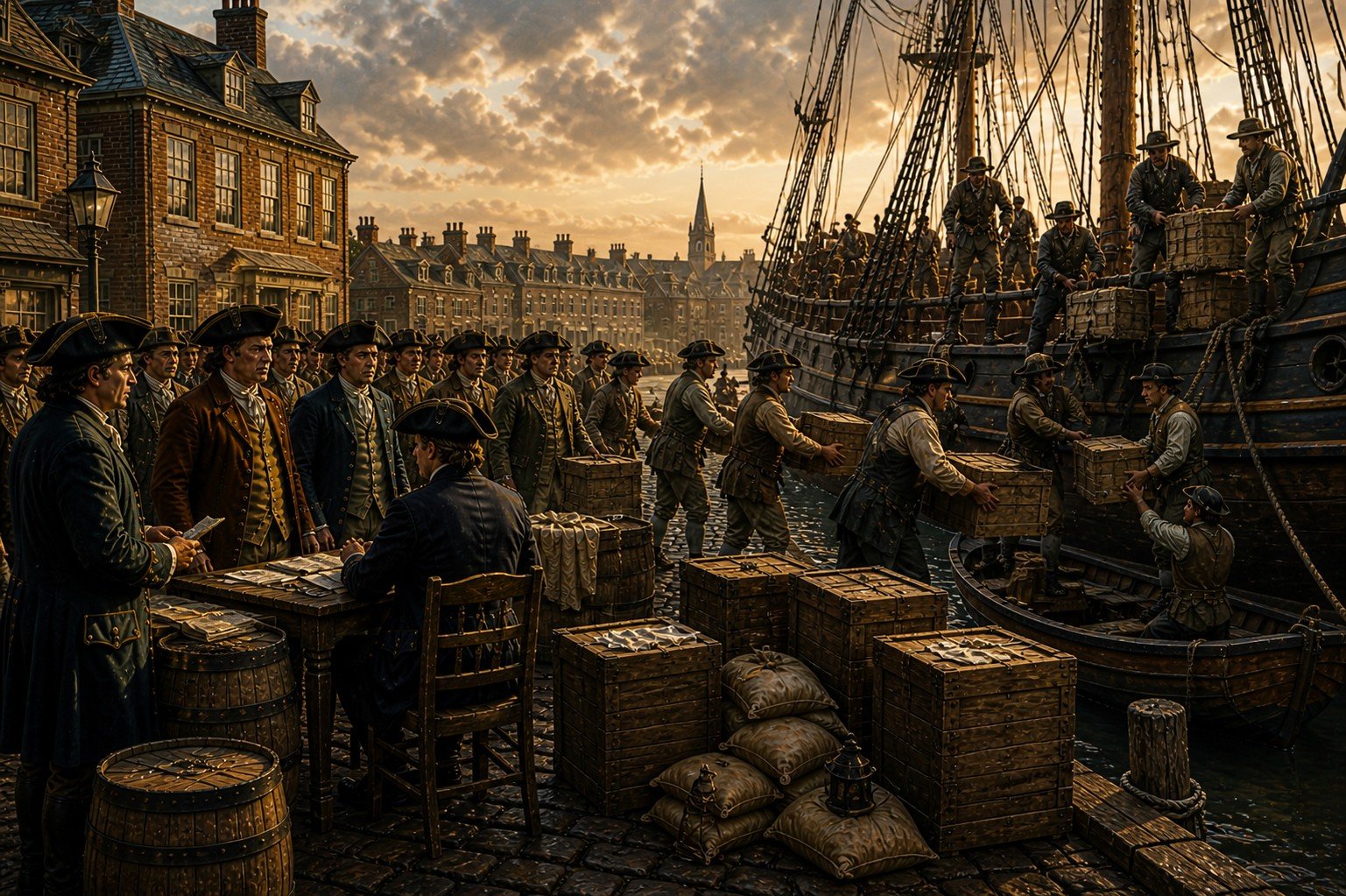
By the early 1770s, the relationship between Britain and the colonies had become increasingly strained. It was in this context that the Tea Act of 1773 was introduced. The act was designed to support the financially troubled British East India Company by allowing it to sell tea directly to the colonies at a reduced price. Whilst this made tea cheaper, it also undercut colonial merchants and maintained the controversial tax on tea.
For many colonists, the Tea Act represented a calculated attempt by Britain to secure acceptance of taxation. Even though the economic impact might have been beneficial to consumers, the principle behind it was unacceptable. The legacy of earlier measures—rooted in the financial aftermath of the French and Indian War—meant that colonists were now highly sensitive to any assertion of Parliamentary authority over taxation.
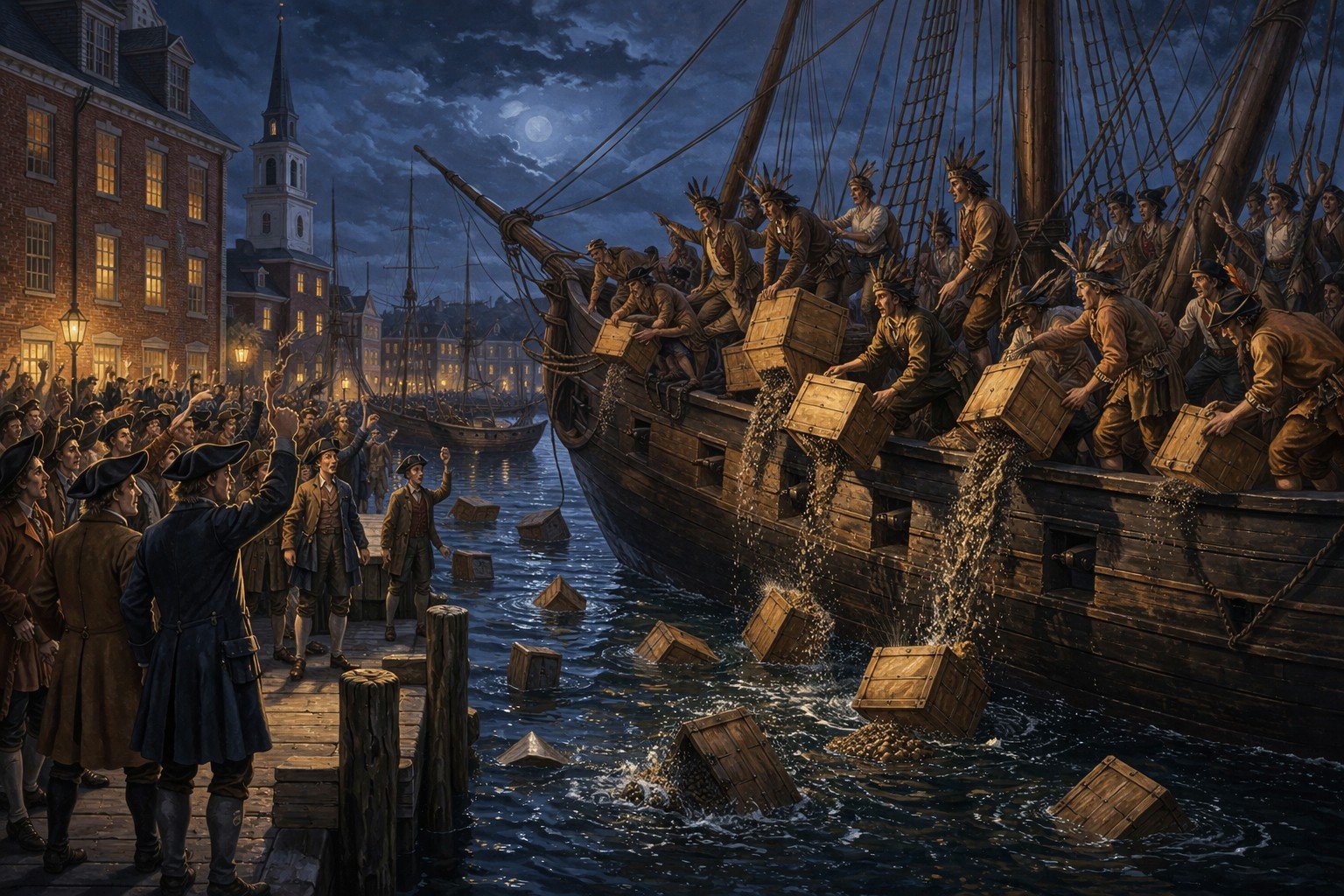
In Boston, resistance quickly organized. Ships carrying tea arrived in the harbor, but colonial leaders insisted that the cargo be returned to Britain without being unloaded. When this did not happen, a decisive act of protest followed. On December 16, 1773, members of the Sons of Liberty and other participants boarded the ships and dumped 342 chests of tea into the harbor, an event that became known as the Boston Tea Party.
Seen in this light, the Boston Tea Party was the culmination of a process that began with the French and Indian War. The war created financial pressures that led Britain to alter its colonial policies. Those policies, in turn, provoked resistance, which escalated over time through protests, confrontations, and increasingly organized acts of defiance.
The connection between the French and Indian War and the Boston Tea Party highlights how large-scale geopolitical events can have far-reaching and unintended consequences. A war fought over territory and influence in North America reshaped imperial policy, disrupted long-standing relationships, and set the colonies on a path toward revolution. The Boston Tea Party was not an isolated incident, but the product of years of mounting tension that began in the aftermath of that earlier conflict.